The voices that echo: Queensland's modern Town Criers
Published on 06 April 2026
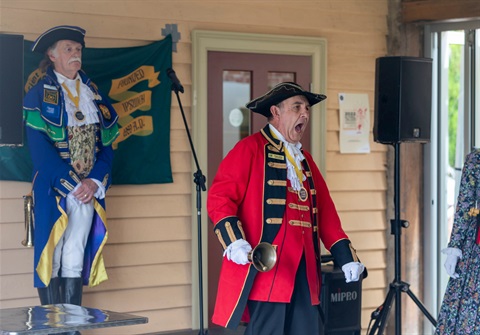
The centuries-old art of town crying endures – and is finding fresh purpose and personality in modern Queensland.
On a sleepy Queensland morning, long before the queues, cars and coffee machines stir the streets fully awake, a figure in bright regalia steps onto a public square.
There’s the theatrical tap of a staff on the footpath. A deep breath drawn into seasoned lungs. And then the unmistakable call that has carried across centuries and continents:
The ancient summons rings out – once a lifeline for the illiterate, now a celebratory echo of history. Queensland may be young by global standards, but it has embraced the town crier with surprising affection.
In Cooktown, Toowoomba and Brisbane (to name just three), the tradition is not only alive but flourishing – supported by councils that recognise the value of ceremony, heritage and a bit of pageantry. In these communities, the town crier remains an audible reminder that some ancient customs never quite fade; they simply evolve.
Long before newspapers were folded into letterboxes, before news bulletins flashed across screens or social media feeds, town criers were the news.
In medieval England, France and much of Europe, literacy was scarce and the spoken word carried the weight of law. Into crowded squares stepped the town crier – a voice appointed by the Crown or local authorities to proclaim taxes, new decrees, market hours and the arrival of ships.
In Britain and its colonies, including early Australia, that same voice carried darker tidings as well — announcing the crimes of those hauled to the stocks and the grim sentences delivered before public executions.
Their authority was so absolute that to lay so much as a hand on a crier was considered treason, and they strode through the streets with bell or staff in hand: unmistakable symbols of a power that was drawn not from the sword, but from the sheer force of their call.
As Europeans spread across the world, they carried the tradition with them, and Australia adopted it swiftly – especially in young settlements where communication was fragile and the town square served as the beating heart of civic life.
The tradition faded as printing presses, the telegraph and, eventually, modern media took hold, but it never disappeared entirely. Instead, it morphed – into civic ceremony, festival entertainment and a role that today carries history, performance and local pride.
And nowhere in Australia is this more evident today than in Queensland.
One Queensland community where a town crier feels more like a continuation than an add-on is Cooktown. Sitting on the edge of the Cape York Peninsula, this community has always worn its history close to the surface – from Captain Cook’s unexpected seven-week repair stop in 1770 to the gold-rush chaos of the 1870s.
Today, that living connection is embodied by Robert “Robbo” Greenwood, Cooktown’s exuberant town crier. A familiar presence, he strides through local celebrations in full regalia – tricorn hat, frock coat and the unmistakable bell – delivering announcements, introducing events and injecting a theatrical flourish wherever he goes.
Cooktown’s crier often collaborates with historical societies, Indigenous leaders and cultural groups to ensure public proclamations honour the region’s past. The ritual call, once a symbol of colonial authority, becomes here a gesture of inclusion – a voice that welcomes rather than commands. In a town where history is both raw and revered, the town crier serves as a bridge: linking eras, connecting communities and giving Cooktown’s stories a voice that still carries.
Toowoomba is well known for its civic pride and festive spirit, and the Garden City’s town crier, Kevin Howarth, fits right into that cultural rhythm.
A seasoned performer with a resonant voice and easy grin, Kevin is one of the few Australian criers regularly sent to national and international competitions (see ‘In The Media’ pages), where bell-ringers and bellowers pit their projection, diction, costume and creativity against each other.
Visitors to Toowoomba’s Carnival of Flowers or Australia Day events can often spot him in his ruffles, ribbons and polished boots, delivering proclamations with the clarity of an opera singer and the charm of a stage veteran. Children gather wide-eyed around him and teenagers film him for social media.
Behind the theatricality lies a deep respect for the craft. Town criers train their voices meticulously: posture for diaphragm power, crisp articulation so words don’t blur in the open air and humour – always humour – to win and hold the crowd.
Toowoomba’s Kevin Howarth exemplifies this blend of discipline and delight, keeping a centuries-old role vibrant in a thoroughly modern setting. It also helps that he serves as an unofficial ambassador; whether introducing local dignitaries, welcoming international visitors or launching events, his presence adds a ceremonial weight that reminds people that formality, when wrapped in colour and character, can still be fun.
In big cities, traditions like town criers can sometimes feel swallowed by scale. Yet Brisbane has managed to maintain its own crier as part of the city’s ceremonial identity.
Brisbane town crier, Mandy Partridge, appears at civic receptions, charity events, major festivals and heritage celebrations in a uniform tailored to Queensland’s climate (lighter fabrics but still unmistakably regal) and cuts an elegant silhouette against the backdrop of the River City’s modern skyline.
Mandy is Brisbane’s first official town crier, a role she’s held since winning a public ‘cry-off’ (pledging to keep her shoes polished and her voice strong) in 2016.
Drawing on her performance background and writing her own ‘cry’ about Brisbane’s past, present and future, Mandy referred to her time away in London and Perth, incorporating what she missed about home.
As Brisbane’s town crier, Mandy embodies the ceremonial heart of the role. This is the crier as herald, a living emblem of civic hospitality. And in a city that is growing as rapidly as Brisbane, the presence of such a figure reminds residents and visitors alike that communities are built on shared stories, rituals and moments that feel larger than everyday life.
In an age of instant notifications and incessant digital chatter, the idea of a town crier might seem, well, quaint. But Queensland proves that some traditions endure not because they are necessary, but because they are meaningful. A bell. A call. A booming voice that slices into the day. It’s a reminder that news was once something you gathered around, listened to and shared as a moment in time.
And in communities like Cooktown, Toowoomba and Brisbane, that moment still happens – loudly, proudly and with a flourish.
Oyez, Queensland. The old voices still echo.
Written by Tim Cox | Senior Communications Advisor, LGAQ